
SEO vs Ads for Contractors: The Faucet and the Well

Hard Labor Marketing logo
Hard Labor Marketing Team

Marketing for blue-collar and home service businesses

Updated Oct 22, 2026

Published Sep 17, 2026

Contractors ask all the time whether they should do SEO or run ads. Wrong question. One is a faucet, one is a well. Here is how to tell which one your shop needs first.

SEO vs Ads for Contractors: The Faucet and the Well
The short answer

Contractors should not choose between SEO and ads because they do different jobs. Ads are like a faucet that produces leads immediately but stops the moment you stop paying. SEO is like a well that takes time to dig, but eventually produces warm leads without a meter running. Most shops need ads to keep the schedule full today while building their website and Google Business Profile to lower lead costs over the long haul.

Key takeaways

  • Paid ads function like a faucet that produces leads instantly when turned on. The downside is that leads stop completely the day you stop paying.
  • SEO functions like a well that takes time to produce results. Once dug, it provides leads that cost less every year without a running meter.
  • Running ads without a solid Google Business Profile and website wastes your budget. Homeowners will check your profile, see missing information, and call another contractor.
  • Local rankings depend on three factors defined by Google: relevance, distance, and prominence. You cannot move your shop, but you can improve your relevance and prominence.
  • Most contractors should combine both channels to protect cash flow. Use ads to fill the schedule right now while steadily building your organic foundation.

How we judge this

  • 1Lead delivery speed
  • 2Ongoing ad spend
  • 3Long term asset value
  • 4Homeowner purchase intent

Google Local Services Ads · Best for immediate calls with verified trust

You pay per lead and carry the Google Guaranteed badge on your listing. This option lets you turn up call volume immediately and track exact costs per booked job. It stops generating leads the moment you pause your spend.

Google Search Ads · Best for controlling immediate keyword traffic

You pay each time a user clicks on your placement in search results. It offers quick visibility and controllable volume to keep your trucks moving. The faucet shuts off entirely as soon as your budget runs out.

Local SEO and Google Business Profile · Best for sustainable leads that lower costs over time

This strategy optimizes your profile, reviews, and website pages for local relevance and prominence. It takes time to build and Google does not provide a guaranteed timeline. Once established, it brings in warmer leads without paying for every click or call.

StrategyDelivery SpeedOngoing Ad SpendAsset ValueHomeowner Intent
Google Local Services AdsImmediateRequired per leadZero once pausedHigh
Google Search AdsImmediateRequired per clickZero once pausedModerate
Local SEO and ProfileSlow to buildNone after rankingLasting assetVery high

Contractors ask me all the time whether they should do SEO or run ads.

Wrong question. They are two different tools and they do two different jobs. Asking which one is better is like asking whether a torque wrench beats a grinder. Depends on what is in front of you.

Here is how I actually explain it on a call.

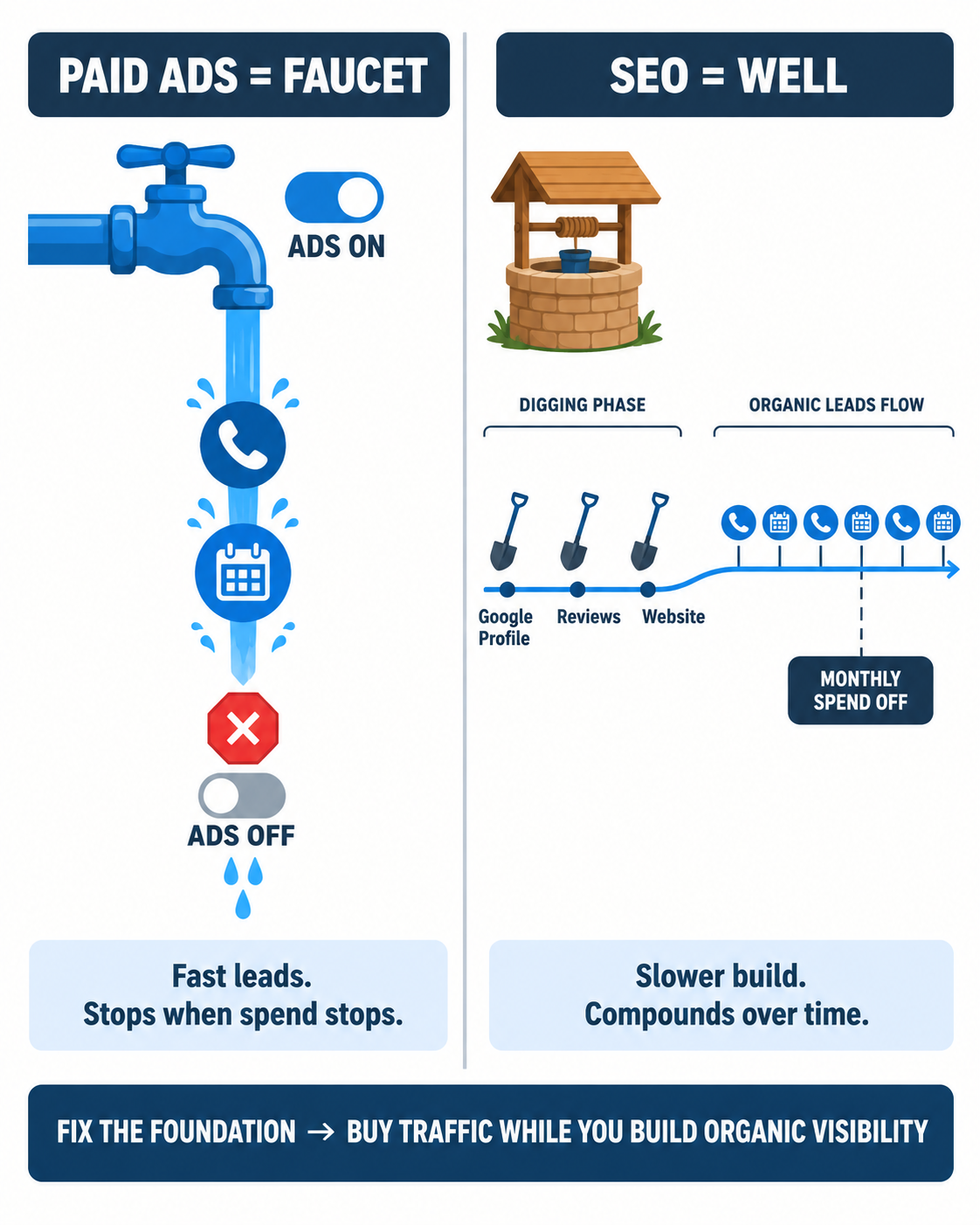
You turn it on, water comes out. You turn it off, it stops. Same day, both directions.

You are paying for placement. With Google Local Services Ads you pay per lead and you carry the Google Guaranteed badge. With Search you pay per click. Either way, the meter runs the whole time the faucet is open.

What you get: speed, and a number you can read. Cost per lead this week versus last week. You know exactly what a booked job costs you, and you can turn the volume up on a slow Tuesday.

What you do not get: anything that keeps working after you stop paying. The day the card gets declined, the phone goes quiet.

SEO is a well

You dig it once. It takes a while. Then it produces without a meter running.

For a trades business, most of this is your Google Business Profile and your website. Google says local ranking comes down to three things: relevance, distance, and prominence. How well you match the search, how close you are to the person searching, and how well known you are.

You cannot move your shop. You can absolutely move the other two.

What you get: leads that cost less every year you keep at it. Somebody searching "AC repair near me" at 2am found you on their own. That is a different homeowner than the one who clicked an ad, and they usually show up warmer.

What you do not get: speed. And I am not going to give you a month count. Google does not publish one. Anybody who tells you "90 days" is making it up.

Which one is actually you

Start with ads if:

  • You need calls this month, not next year
  • You are new, or you just opened a new service area
  • Your profile is thin. Few reviews, no photos, nothing to rank yet
  • You have trucks sitting idle and payroll on Friday

Start with SEO if:

  • You already have a review base and years in the market
  • Your ad costs keep climbing and the math is getting worse
  • You cannot fund a real ad budget month after month
  • You are playing a 5 year game, not a 90 day one

The part most shops miss

If your Google profile is a mess and your website does not say what city you are in, ads will not save you.

The homeowner clicks, looks you up, finds nothing, and calls the next guy. You just paid for a lead you had no chance of closing. That is not an ad problem. That is a foundation problem, and no budget fixes it.

Fix the foundation. Then buy the traffic.

Foundation means the boring stuff: correct categories and service list on your Google Business Profile, real photos of your crew and your work, a steady flow of reviews, and a website that names your city and your services in plain language.

Most shops need both

Ads keep the lights on while the well gets dug.

You run Local Services Ads to fill the schedule this month. At the same time, you are stacking reviews, publishing real service and city pages, and getting your profile in order. Twelve months later your cost per booked job is down, because a chunk of your calls stopped coming from the meter.

The mistake is not picking the wrong one. It is picking one and never building the other.

How we run it

With most of the shops we work with, the first 90 days look like this:

  1. Fix the foundation first. Profile, reviews, photos, and the pages that tell Google where you work and what you do.
  2. Turn the faucet on. Local Services Ads first, because you pay per lead and the badge does a lot of the trust work for you.
  3. Track cost per booked job, not cost per click. Clicks do not pay payroll.
  4. Keep digging the well while the faucet runs, and watch the paid share of your calls drop over time.

If you want somebody to look at your profile, your site, and your ad numbers and tell you straight which one you need first, book a call. Bring your revenue, your service mix, and your market.

Case study

Phaze Electric LLC

A custom 18 page site, original job site media, and 363.6% more LinkedIn views

FAQ

Frequently asked questions

How quickly does contractor SEO start generating calls?

Google does not publish a timeline for local ranking results. Anyone who promises results in 90 days is making it up. SEO takes time to build, but it keeps producing leads long after the work is done.

Why should a shop avoid relying solely on paid ads?

Relying only on ads means your business depends entirely on an open meter. If your card gets declined or ad costs climb, call volume drops to zero immediately. You build no lasting asset that brings in free calls.

What makes a solid digital foundation for a trade business?

A solid foundation includes a verified Google Business Profile with correct categories and service lists. It also requires genuine crew photos, steady incoming reviews, and website pages that clearly name your city and services.

When should a contractor prioritize paid ads first?

Start with ads if you have idle trucks, payroll to meet on Friday, or a newly launched service area. They are also necessary if your profile is thin with few reviews and photos to rank organically.

How does Google determine local organic rankings?

Google determines local ranking through relevance, distance, and prominence. You cannot move where your shop is located relative to searchers. However, you can actively improve your relevance and how well known your business is.