
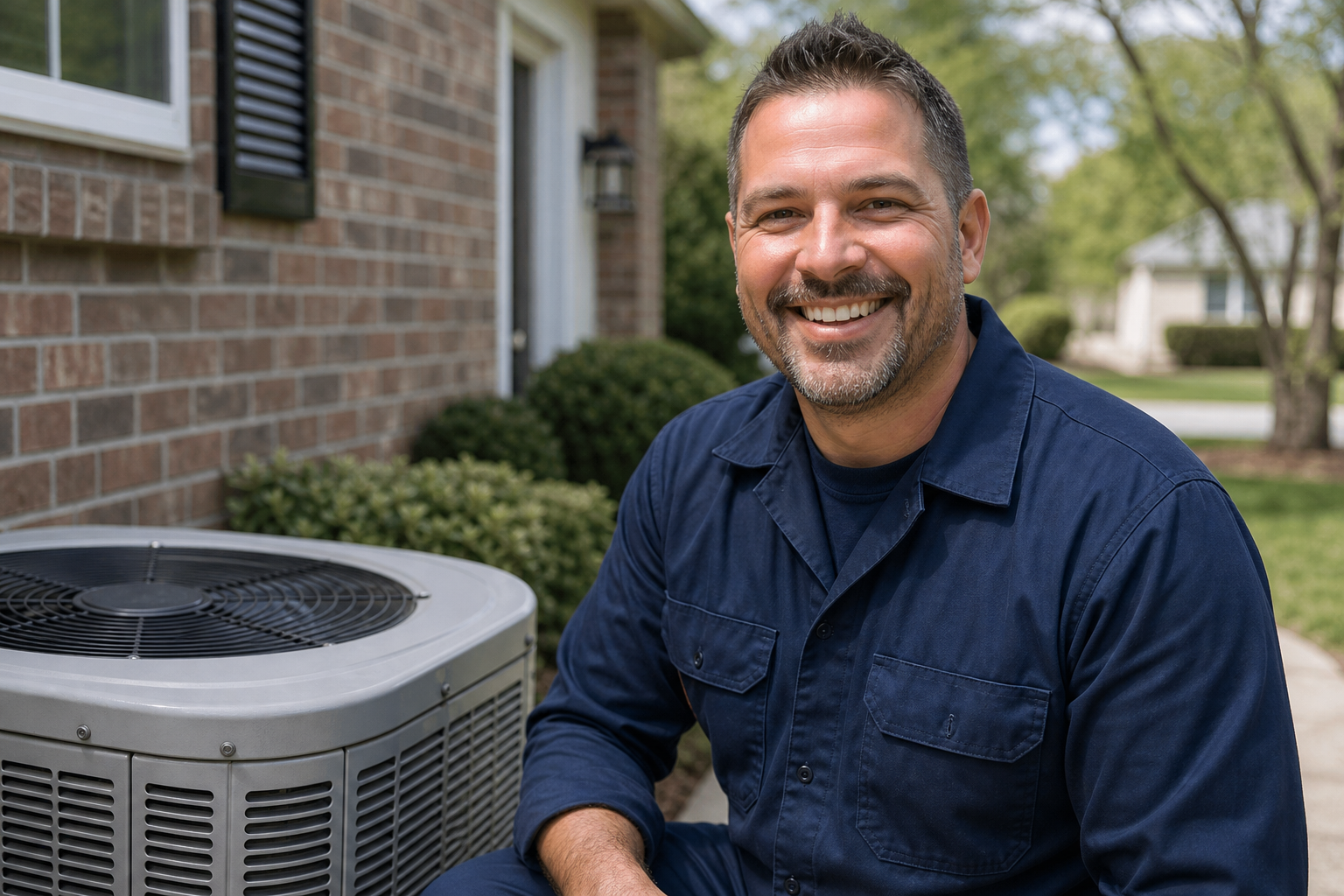
You’re not just selling a fixed capacitor or a cleared drain. You’re selling a stranger’s entry into a private home.
In the trades, we get used to the dirt. We forget that for a homeowner-especially a woman home alone or a parent with small kids-opening the door to a guy in a work shirt carries a level of subconscious anxiety. That anxiety is the "friction" that causes no-shows, price shopping, and ghosted estimates.
If your website is nothing but stock photos of a generic guy in a hardhat holding a wrench, you aren’t building trust. You’re hiding.
Showing your crew’s faces isn’t about vanity. It’s about eliminating the "Stranger Danger" factor before the dispatch fee is even discussed. When a customer sees the face of the human being who will be standing in their hallway, the lizard brain relaxes.
The Psychological Power of the Handshake Before the Handshake
Most contractors think their "brand" is their logo or the wrap on their truck. Wrong. Your brand is the face of the guy holding the manifold gauges.
When you put your technicians' faces on your website and in your booking confirmations, you’re performing a "digital handshake." You are converting an anonymous transaction into a human relationship.
Human beings are wired to look for faces. It’s a survival instinct. We scan for intent, friendliness, and professionalism. If you refuse to show your team, the customer’s brain fills in the blanks-usually with a stereotype of a grimy, untrustworthy "service guy" who’s going to overcharge them.
Think of it like this: Buying home services online without seeing the team is like blind-dating a person who won't show you their profile picture. You might show up, but you're going to be on high alert the whole time.
Homeowners judge your company in 3 seconds flat, and most of that judgment is based on whether they feel safe and "seen" by your brand.

Why Stock Photos are Killing Your Closing Rate
If I see one more HVAC website with that same stock photo of the blonde woman pointing at an AC unit while a guy in a pristine white shirt smiles at her, I’m going to lose it.
Your customers aren't stupid. They know what a stock photo looks like. When you use them, you’re sending a clear message: “We don’t actually have a team we’re proud of,” or “We’re too lazy to take a real photo.”
Comparison of Impact: Real Faces vs. Stock Photos
| Feature | Real Team Photos | Stock Photos | | :--- | :--- | :--- | | Trust Factor | High (Shows accountability) | Low (Feels like a "lead gen" scam) | | No-Show Rate | Decreases by 15-20% | Stays average | | Conversion Rate | 2x-3x higher on Service pages | Standard or declining | | Brand Recall | Homeowner remembers "Dave" | Homeowner remembers "the blue truck" |
Real photos prove you exist. They prove you have a culture. Most importantly, they prove you aren't a fly-by-night operation working out of the back of a rusted-out 1998 Econoline. The stock photo trap kills credibility faster than a bad Yelp review ever could.
The "Bio-Card" Tactic: Real Numbers, Real Wins
We’ve seen HVAC and plumbing companies implement "Tech Bio-Cards" in their automated dispatch emails (ServiceTitan, Housecall Pro, etc.).
Instead of a generic "Your tech is on the way" text, the customer gets a link to a small profile. It shows the tech's face, their years of experience, a fun fact (like "has two golden retrievers"), and a 15-second intro video.
The result?
- Higher Tips: Customers feel a personal connection.
- Fewer "Not Home" No-Shows: It’s harder to stand up "Mike" than it is to stand up "The HVAC Company."
- Higher Ticket Averages: Trust allows the tech to make recommendations that the customer actually listens to.

Video: The 15-Second Trust Accelerator
If a picture is worth a thousand words, a video is worth a thousand leads. You don't need a film crew. You need an iPhone and a tech who can speak clearly for 20 seconds.
Have your senior techs film a quick "Who I Am" video.
- "Hey, I’m Chris. I’ve been a plumber for 12 years. My goal today is to get your water back on and make sure your house is cleaner when I leave than when I arrived. See you soon."
That’s it. That is the entire script. Why 89% of buyers say video convinced them boils down to one thing: body language. They can hear the tone of Chris’s voice. They see he isn't a serial killer. They relax.
When that tech knocks on the door, the "interrogation" phase of the sales process is already over. The customer is already in "solution" mode because the trust was established through the screen.
How to Execute Without Making it Weird
You don't need your guys to be underwear models. You need them to look like the professionals they are. Here is the Hard Labor playbook for getting this done:
- Group Shots for the Homepage: Show the whole fleet and the whole crew. It conveys scale and stability.
- Individual "Meet the Team" Bios: Each tech gets a headshot in a clean uniform. No sunglasses. No hats that shadow the eyes.
- Action Shots: Don't just do "deer in headlights" poses. Show them actually looking at a circuit board or holding a pipe wrench. It proves expertise.
- The "Cleanliness" Shot: Include a photo of your tech putting on shoe covers or laying down a floor protector. It addresses the #1 fear homeowners have: "Is this guy going to wreck my floors?"
Stop Hiding Behind Your Logo
If your competitors are hiding behind stock photos and generic logos, you have a massive opportunity to eat their lunch. By humanizing your brand, you move out of the "commodity" category where people only care about the lowest price.
You become the "safe" choice. And in home services, the safe choice always gets the signature on the estimate.
Stop being a faceless business. Get a photographer out to your shop for half a day, get your guys in clean shirts, and get those faces on your website. If you want to stop fighting for scraps and start winning the high-margin jobs, you have to let your customers see who they're inviting into their lives.
Ready to stop looking like every other "Chuck in a truck" out there? Book a strategy call with Hard Labor Marketing today. We’ll audit your site, kill the stock photos, and help you build a brand that homeowners actually trust.