
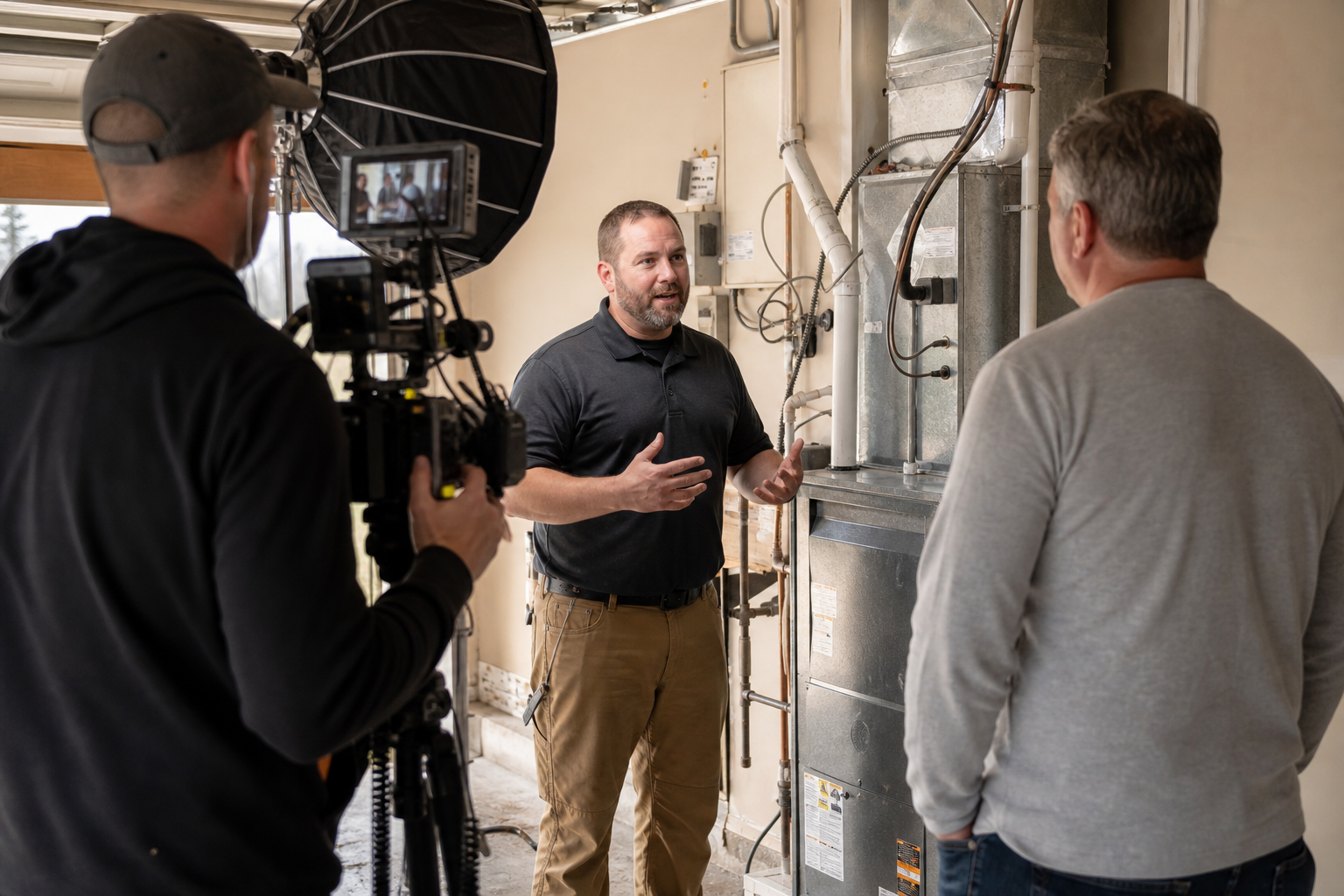
Video Marketing For Contractors: A No-Excuses Playbook

Hard Labor Marketing logo
Hard Labor Marketing Team

Marketing for blue-collar and home service businesses

Updated Oct 22, 2026

Published Jun 19, 2026

Top performing video types for contractors - walkthroughs, team intros, testimonials, FAQs - and how to track if they generate calls.

Video Marketing For Contractors: A No-Excuses Playbook
The short answer

Contractors do not need expensive gear or polished studios to win jobs with video. Authentic, simple videos shot on a smartphone build faster trust with homeowners than slick corporate ads or fake stock photos. Focusing on quick project walkthroughs, tech introductions, common customer questions, and real client reviews proves your crew is legitimate. Distributing those clips on your Google Business Profile, YouTube, and paid social ads reduces lead costs and turns your daily field work into reliable proof.

Key takeaways

  • Overly polished footage can make your shop look expensive and corporate rather than approachable. Pulling out a smartphone on a real job site shows authentic proof that your team can solve immediate problems.
  • Homeowners make quick trust judgments within three seconds when searching for a contractor. Showing actual technicians, marked trucks, and clean work immediately eliminates the skepticism caused by generic stock photos.
  • Four specific video styles drive results: project walkthroughs, technician introductions, answers to common customer questions, and customer testimonials. You do not need dozens of complicated concepts to outpace local competitors.
  • Running problem and solution videos in paid ads can cut cost per lead by 20 to 30 percent compared to static image ads. Video assets also perform well when added directly to your Google Business Profile, YouTube channel, and staff email signatures.
  • Track clear business results instead of chasing vanity metrics like likes or views. Use dedicated tracking phone numbers and monitor viewer dropoff rates to verify that your videos are booking real service calls.

How we judge this

  • 1Production effort
  • 2Trust impact
  • 3Primary goal
  • 4Best distribution channel

Project Walkthrough · Best for showing technical skill on completed jobs

Record a quick 60-second clip on the job site highlighting the initial problem, the completed installation, and tidy workmanship. Finish with a call to action encouraging homeowners with aging units to call before disaster strikes. This format gives potential clients visual proof that your crew does clean work.

Meet the Team Video · Best for easing customer fear of strangers entering homes

Introduce your lead technicians on camera so homeowners can see their faces and hear their voices before an appointment. This humanizes your business and reassures customers that your crew is polite and professional. It works especially well when linked in staff email signatures.

FAQ Value Video · Best for answering common pricing and repair questions

Have your team answer the top five questions your office staff receives every week, such as system pricing or troubleshooting noises. These clips establish your technicians as helpful local authorities who explain issues clearly. Posting them helps educate homeowners before they ever book a diagnostic call.

Video Testimonial · Best for providing undeniable social proof from real clients

Capture satisfied customers on camera describing how your team resolved their emergency or home problem. Video reviews carry far more emotional weight than written comments because they cannot be easily faked. These assets provide strong conversion power when featured on landing pages and social ads.

FormatProduction EffortTrust ImpactPrimary GoalBest Channel
Project WalkthroughMinimal smartphone recordingHigh proof of skillShow real job resultsGoogle Business Profile and ads
Meet the Team VideoQuick technician interviewHigh comfort with crewHumanize field staffEmail signatures and website
FAQ Value VideoShort on-camera answersHigh expert authorityAnswer common pricing questionsYouTube search and website
Video TestimonialShort customer interviewMaximum emotional proofValidate quality of serviceWebsite and social ads

Most contractors treat video like a chore they can put off until next season. They think they need a Spielberg budget, a 4K camera rig, and a teleprompter to look professional.

That’s dead wrong. In the trades, perfection is actually a liability.

If you look too polished, you look expensive and corporate. If you look like a real person standing in front of a real truck talking about a real problem, you look like the guy who can fix a furnace at 2:00 AM.

Video is the only marketing tool that builds trust while you sleep. It’s the closest thing you have to a salesperson who never gets tired, never asks for a commission, and never calls out sick.
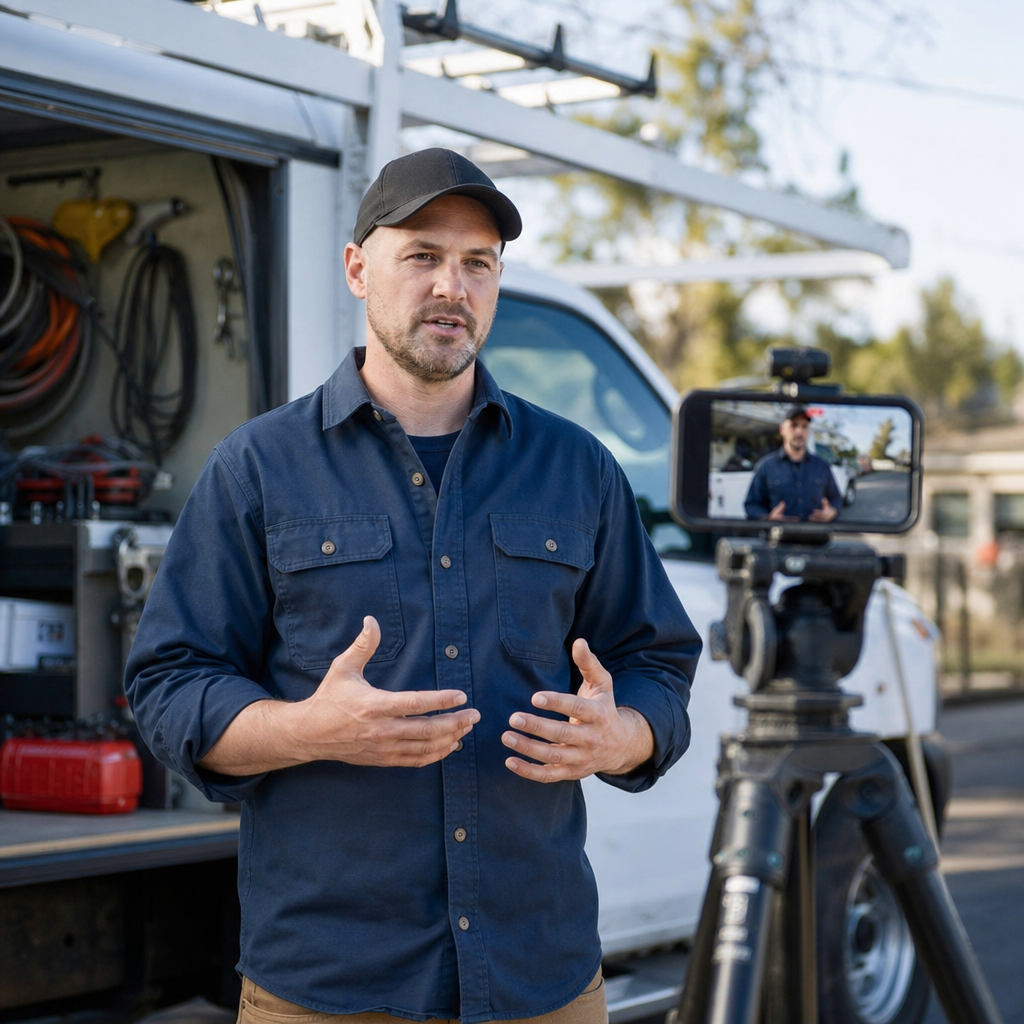
A smartphone on a tripod recording a contractor giving a short on-camera testimonial outsi

The Three-Second Rule of Trust

When a homeowner’s basement is flooding, they aren't looking for a cinematic masterpiece. They are looking for a reason to trust you. Homeowners judge your company in 3 seconds flat, and nothing passes that test faster than a video of your actual team.

Stop using stock footage of a smiling guy in a clean hardhat who doesn't work for you. The stock photo trap kills credibility because it feels fake. People can smell a "purchased" brand from a mile away.

Video proves you exist. It proves you have trucks, tools, and a crew that doesn't look like they just fell out of a patrol car.

The High-Impact Video Menu

You don't need a thousand videos. You need four specific types that move the needle. If you produce these, you’ll outpace 90% of your local competition.

1. The Project Walkthrough

This is your bread and butter. After a job is done, take 60 seconds to show what you did.

  • The Hook: "We're out here in [City Name] fixing a water heater that's been leaking for three days."
  • The Meat: Show the old, rusted unit versus the new, clean install. Point out the tidy soldering and the expansion tank.
  • The Close: "If your heater is over 10 years old, give us a call before this happens to you."

2. The Meet the Team Video

Homeowners are terrified of letting strangers into their houses. Use video to introduce your lead techs. Let them see the face, hear the voice, and realize your guys are polite professionals.

3. The FAQ "Value" Video

Take the five questions your office staff hears most often and answer them on camera.

  • "How much does a new AC unit actually cost?"
  • "Why is my drain gurgling?"
  • "What’s the difference between a repair and a replacement?"

4. The Video Testimonial

A written Google review is great. A video of Mrs. Jones standing in her dry basement saying, "These guys saved my house," is gold. It’s impossible to fake and carries 10x the emotional weight.

Production Reality: Phone vs. Pro

You don't need to overthink this. Here is how the two styles actually stack up for a local service business.

| Feature | Smartphone "Raw" Video | Professional Production | | :--- | :--- | :--- | | Cost | $0 (Already in your pocket) | $1,500 - $5,000+ per day | | Trust Factor | High (Authentic, "Real Time") | Moderate (Can feel like a commercial) | | Speed | Shoot and post in 10 minutes | 2-4 week turnaround | | Shelf Life | Great for Social/Ads | Great for Home Page/About Us |

A close-up of an editing timeline on a laptop screen with video clips, hands on keyboard,

Where to Put Your Videos for Maximum CPL Impact

Making the video is 20% of the battle. The other 80% is making sure people actually see it. If a video sits on your hard drive, it's a paperweight.

  • Google Business Profile (GBP): Upload your walkthroughs here. When people find you on Maps, they’ll see your work immediately.
  • YouTube: Google owns YouTube. If you title your video "AC Repair in [Your City]," you’re helping your SEO.
  • Facebook/Instagram Ads: This is where the money is made. A "Problem/Solution" video as an ad usually sees a 20-30% lower Cost Per Lead (CPL) than a static image ad.
  • Email Signatures: Put a "Meet the Owner" link in your techs’ email signatures. It warms up the lead before they even knock on the door.

The "Check Engine Light" Strategy

Think of your marketing like a truck. If you don't have video, your "Trust" engine is running lean.

Statistics show that why 89% of buyers say video convinced them to make a purchase is rooted in the "Show, Don't Tell" principle. You can tell a customer you’re the best plumber in town until you’re blue in the face.

But when they see a video of you explaining how a sewer camera works, they see an expert. They don't need to take your word for it-they have visual proof.

Tracking the ROI (Don't Guess)

We aren't doing this for "likes" or "clout." We're doing this for phone calls and booked jobs.

  1. Unique Tracking Numbers: Use a specific CallRail number on your video ads to see exactly how many people called after watching.
  2. View-Through Conversions: If you're running Facebook ads, track how many people watched 50% of your video and then visited your site to book.
  3. Engagement Metrics: If people are dropping off in the first 3 seconds, your intro is boring. If they stay for 30 seconds, they are interested in the service.

No Excuses: Your 30-Day Plan

Stop waiting for a "good time" to start. Your competition is either already doing this or they're too scared to try. Either way, there is a window of opportunity right now.

Next time you’re on a job site that looks clean, pull out your phone. Don't overthink the script. Just say what happened, show why it matters, and tell them what to do next. That's a marketing asset. Do that twice a week for a month and watch what happens to your lead quality.

Ready to stop playing around with your marketing and start dominating your local market? Contact Hard Labor Marketing today. We’ll help you cut through the noise, skip the fluff, and build a video strategy that actually puts trucks in driveways.

Case study

Phaze Electric LLC

A custom 18 page site, original job site media, and 363.6% more LinkedIn views

FAQ

Frequently asked questions

Do contractors need professional camera gear to make effective videos?

No, you do not need an expensive camera, a teleprompter, or high production budgets. A basic smartphone camera in your pocket is enough to record clean, authentic job clips. In fact, raw videos often build more trust with homeowners than slick corporate productions.

Why are stock photos and videos bad for trade marketing?

Stock footage often looks fake and can make your company seem untrustworthy. Homeowners can quickly tell when imagery was purchased rather than taken from actual job sites. Real videos prove that you possess actual trucks, equipment, and a qualified crew.

How does video marketing lower advertising costs?

Video ads that highlight a problem and solution typically achieve a 20 to 30 percent lower cost per lead than static image ads. They engage viewers much faster and clearly explain the service before the customer calls. This extra clarity helps generate higher quality inquiries.

Where should contractors post their videos?

Upload walkthroughs to your Google Business Profile so local searchers see your work immediately on Maps. You should also publish videos to YouTube for search visibility and run them on Facebook or Instagram ads. Adding team video links to technician email signatures warms up leads before service visits.

What should a contractor say in a 60-second job walkthrough video?

Start with a clear hook stating your city and the specific problem you are fixing. Next, show the old equipment compared to your new installation while pointing out clean workmanship. Finish with a call to action telling homeowners to call your shop before their system fails.

How should contractors track whether video marketing is working?

Use dedicated call tracking numbers on your video advertisements to see how many phone calls come directly from viewers. On platforms like Facebook, check view-through conversions to see if people who watched the clip visited your site to schedule service. Also monitor viewer dropoff rates during the first few seconds to gauge audience interest.